
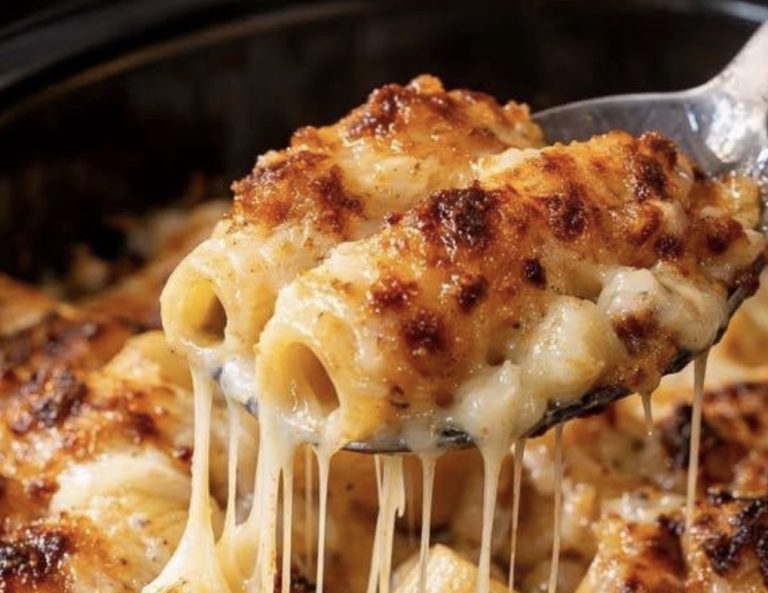
This 5-ingredient slow cooker poor man’s spring tortiglioni is the kind of set-it-and-forget-it supper that fits right into a busy workday. I grew up in the rural Midwest where a hot, cheesy pasta dish was as good as a hug after a long day in the fields. This version leans on dry ridged curved pasta tubes, a jar of sauce, and a handful of simple ingredients you can grab at any small-town grocery.
You toss everything into the slow cooker before work, and by the time you walk back through the door, the house smells like Sunday dinner and the pasta is bubbling, with a golden, caramelized cheese crust on top. It’s humble, hearty, and made for those evenings when your husband is already reaching for the bowls before you even take off your coat.
Slow cooker tortiglioni bubbling with browned cheese on top
Slow cooker tortiglioni bubbling with browned cheese on top
Serve this rich, cheesy tortiglioni with a crisp green salad—just lettuce, a few sliced radishes, and a simple vinaigrette works fine—to balance the creaminess. Warm garlic bread or buttered toast from plain sandwich bread makes a lovely, practical side, especially in a farmhouse kitchen. A dish of cottage cheese or sliced cucumbers with salt and pepper feels very Midwestern and keeps things light. If you enjoy wine, a modest glass of red table wine pairs nicely, but around here a tall glass of iced tea or cold milk is just as welcome.
5-Ingredient Slow Cooker Poor Man’s Spring Tortiglioni
Ingredients
12 oz dry ridged curved pasta tubes (tortiglioni or similar)
24 oz jar light tomato-basil pasta sauce
2 cups water
1 cup frozen spring vegetables (peas, carrots, and corn blend)
2 cups shredded mozzarella cheese, divided
Simple ingredients for tortiglioni arranged on a farmhouse counter
Simple ingredients for tortiglioni arranged on a farmhouse counter
Directions
Lightly grease the inside of a 4- to 6-quart slow cooker with a bit of oil or nonstick spray to help keep the pasta from sticking and to make cleanup easier.
Pour the entire jar of tomato-basil pasta sauce into the slow cooker, then add the 2 cups of water. Stir together until the sauce and water are evenly combined to make a loose, soupy mixture.
Add the dry ridged curved pasta tubes directly to the slow cooker. Stir well so every piece of pasta is coated and submerged as much as possible in the saucy liquid. The ridges will help catch the sauce as it cooks.
Dry tortiglioni being stirred into sauce in a slow cooker
Dry tortiglioni being stirred into sauce in a slow cooker
Stir in the frozen spring vegetables, breaking up any large clumps. Make sure they are distributed evenly among the pasta so you get a bit of color and sweetness in every scoop.
Sprinkle 1 cup of the shredded mozzarella cheese over the top of the saucy pasta mixture, then gently push it down with the back of a spoon so it sits just below the surface. This helps create a creamy middle layer as it melts.
Cover the slow cooker with the lid and cook on LOW for 4 to 5 hours, or until the pasta is tender but not mushy. Avoid lifting the lid during the first 3 hours so the heat and moisture stay trapped inside.
About 20 to 30 minutes before serving, remove the lid and gently stir the pasta from the edges toward the center to loosen any pieces that may be sticking and to redistribute the vegetables and cheese.
Cooked pasta in the slow cooker with vegetables and melted cheese
Cooked pasta in the slow cooker with vegetables and melted cheese
Smooth the top of the pasta, then sprinkle the remaining 1 cup of shredded mozzarella cheese evenly over the surface. Replace the lid slightly askew to allow a bit of steam to escape while still keeping in most of the heat.
Turn the slow cooker to HIGH for the last 20 to 30 minutes, or until the cheese on top is fully melted, bubbly, and beginning to brown around the edges. If your slow cooker insert is oven-safe and you want extra caramelized, crispy edges, you can place it (without the lid) under a preheated broiler for 2 to 4 minutes, watching very closely so it does not burn.
Once the cheese is golden and the sauce is thick and creamy around the ridged tubes, turn off the heat and let the pasta rest for 5 to 10 minutes with the lid off. This helps the sauce settle and cling to the pasta, making it easier to scoop into bowls.
Golden cheesy tortiglioni resting in the slow cooker before serving
Golden cheesy tortiglioni resting in the slow cooker before serving
Serve the tortiglioni straight from the slow cooker, digging deep to capture the creamy sauce underneath and the browned, cheesy top. Enjoy hot, while the cheese is still stretchy and the edges are a little crisp.
Variations & Tips
You can easily nudge this simple pantry supper in different directions while keeping it practical. For extra protein, stir in 1 to 1 1/2 cups of cooked ground beef, Italian sausage, or diced leftover ham along with the pasta and vegetables; just be sure any meat is fully cooked and drained of grease before adding, so the sauce does not become oily.
If you prefer a creamier bake, replace 1/2 cup of the water with heavy cream or evaporated milk, stirring it in with the sauce at the beginning. Those who like a little zip can sprinkle red pepper flakes or black pepper over the top cheese layer before the final 20 to 30 minutes. To stretch the meal further for a big family, add up to 2 more cups of frozen vegetables, such as broccoli florets or extra peas, and a splash more water if the mixture looks too thick before cooking.
A hearty bowl of tortiglioni served with salad and buttered bread
A hearty bowl of tortiglioni served with salad and buttered bread
If you cannot find tortiglioni, any dry ridged curved tube such as rigatoni or large elbow macaroni will work; just check tenderness a bit earlier the first time you make it. For food safety, always use cooked meats if you add them, and do not leave the finished dish sitting on the “warm” setting for more than 2 hours.
Refrigerate leftovers within 2 hours of cooking in shallow containers, and reheat until steaming hot throughout before serving again. Avoid cooking this on HIGH from the start, as the pasta can overcook around the edges while staying firm in the center; the LOW setting gives you that tender, creamy texture with nicely caramelized cheese on top